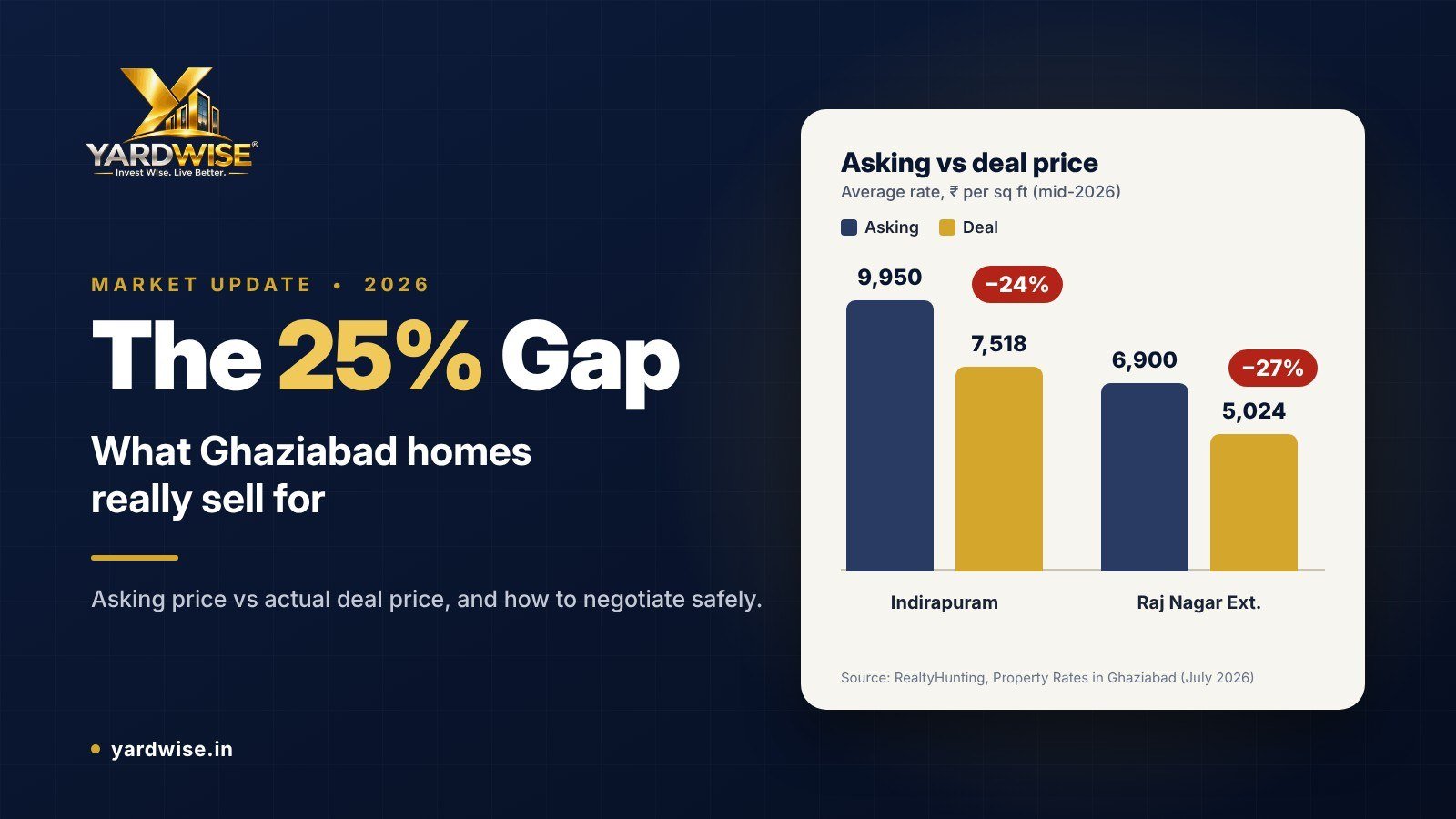
If you have been browsing flats in Ghaziabad, you have probably seen rates like ₹6,900 per sq ft for Raj Nagar Extension or close to ₹10,000 per sq ft for Indirapuram. Those numbers are real, but they are asking prices: what sellers hope to get. What buyers actually pay is often much lower.
This guide looks at that gap with 2026 data, explains why it exists, and shows you how to use it to negotiate without cutting any legal corners.
The gap in numbers
Mid-2026 market data published by RealtyHunting compares average asking rates with average transaction rates:
- Indirapuram: asking around ₹9,950 per sq ft, transactions around ₹7,518 per sq ft. A gap of about 24%.
- Raj Nagar Extension: asking around ₹6,900 per sq ft, transactions around ₹5,024 per sq ft. A gap of about 27%.
Square Yards shows the same pattern for Raj Nagar Extension. Its average asking price is ₹6,606 per sq ft, while the average registered rate for deals recorded between April 2025 and March 2026 was ₹4,150 per sq ft. That registry sample had only 8 transactions, so treat it as a signal, not a rule.
On a 1,000 sq ft flat in Raj Nagar Extension, the difference between the average asking rate and the average deal rate comes to almost ₹19 lakh.
Why the gap exists
A gap does not automatically mean every seller is overpricing. Several things push the two numbers apart:
- Room to negotiate. Most sellers list higher than the price they expect, because they know buyers will bargain.
- Different homes in each list. Online listings lean towards newer, bigger and better-located flats. Registered deals also include older flats, smaller units, lower floors and resale homes that were never advertised.
- Stale listings. A flat that has not sold for months often stays online at its first price.
- Small samples. In some areas only a handful of deals are recorded in a period, so one unusual sale can move the average.
So read the data this way: the asking price is where the conversation starts, not where it ends.
How to find what homes really sell for
You do not have to rely on anyone's word. Three practical checks:
- Search registered deeds on IGRS UP. The Stamp and Registration Department of Uttar Pradesh runs igrsup.gov.in, which offers property search, certified copies of deeds and encumbrance search. Use it to look up past registrations in the society or area you like.
- Compare the same society, not the whole locality. A locality average mixes premium and budget projects. Two or three recent deals in the same society tell you far more.
- Talk to residents and the society office. People who bought recently often share what they paid, and the maintenance office knows which flats changed hands.
Know the floor: the circle rate
Every area has a circle rate: the minimum value fixed by the district administration for stamp duty. In Uttar Pradesh, stamp duty is charged on the higher of the deal value and the circle-rate value:
- 7% for a man buying alone
- 6.5% for a joint purchase by a man and a woman
- 6% for a woman buying in her sole name (a state-set value limit applies, so check the current limit before registry)
- Plus a 1% registration fee for everyone
Ghaziabad's circle rates have been rising. The district raised them by an average of 15% in September 2024, and a further revision of up to 40% in some areas was proposed in September 2025. A higher circle rate limits how low a registered deal can go, so always check the current circle rate for the exact sector before you agree on a price.
Work out your stamp duty and registration cost here
How to use the gap to negotiate, the safe way
- Start from data, not from the listing. Show two or three recent deal values from the same society and make your first offer close to them.
- Point to the condition of the flat. Old fittings, a lower floor, no covered parking or pending society dues are fair reasons for a lower price.
- Show that you are a serious buyer. A pre-approved home loan and flexible timelines often matter more to a seller than the last ₹50,000.
- Put everything in writing. Get a written receipt for every payment, including the token amount.
The one thing you should never do
Some sellers suggest showing a lower value in the sale deed and taking the rest in cash. Do not agree to it. It is stamp duty evasion, the cash part is not protected if the deal goes wrong, your home loan will be based on the lower value, and both buyer and seller can face income-tax questions when the deed value is below the official stamp value. Speak to your CA if anyone proposes it.
Quick checklist before you make an offer
- Asking prices of 5 to 6 similar flats in the same society
- Two or three recent registered deals in that society
- The current circle rate for the exact sector
- Your total cost, including stamp duty, registration and maintenance deposit
- Title, approvals and loan checks on the property
Need help? Book a free consultation with Yardwise. We share recent deal data for the society you like and check the documents before you pay.
Explore Raj Nagar Extension: rates, connectivity and properties