Two flats can both be advertised as "1,200 sq ft" and still feel completely different once you walk in. The reason is simple: the number on the brochure is not always the space you live in. Property in India is described with three different area figures, and knowing how they relate can save you lakhs and a lot of disappointment.
This guide explains each one, what the law says, and how to check the numbers yourself, with a worked example you can follow.
The three areas in plain words
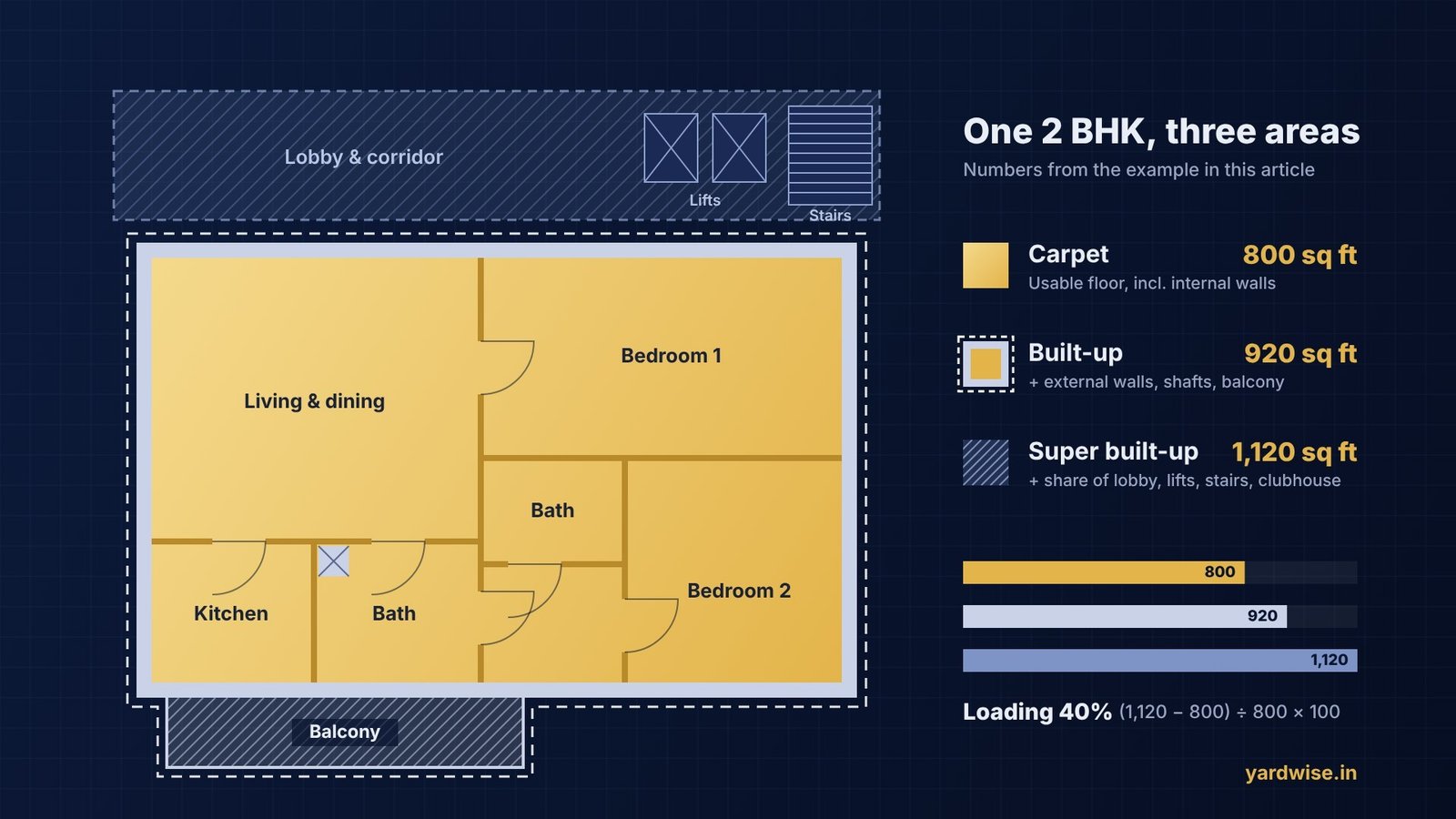
- Carpet area: the usable floor inside your flat. Bedrooms, living room, kitchen, bathrooms and internal passages, including the thin walls between rooms.
- Built-up area: carpet area plus the outer walls of the flat, service shafts and your own balcony.
- Super built-up area: built-up area plus your share of the building's common spaces, such as the lobby, corridors, lifts, staircases and clubhouse. Builders often call this the "saleable area".
Each step up adds area you pay for but cannot put furniture on.
What RERA says about carpet area
The Real Estate (Regulation and Development) Act, 2016 gives carpet area a legal definition in Section 2(k). In short, it is the net usable floor area of an apartment. It includes the area under internal partition walls, but leaves out the external walls, service shafts, an exclusive balcony or verandah, and an exclusive open terrace.
For RERA-registered projects, the price of a flat has to be based on this carpet area, and the agreement for sale must state it.
Quick check: multiply the RERA carpet area in your agreement by the rate per sq ft. The answer should match the base price. If it does not, ask the builder to explain in writing.
Loading: the gap between what you use and what is quoted
The difference between the super built-up area and the carpet area is called loading. It is usually written as a percentage of the carpet area:
Loading % = (Super built-up area − Carpet area) ÷ Carpet area × 100
So if the super built-up area is 1,300 sq ft and the carpet area is 1,000 sq ft, the loading is 30%.
Loading has been rising as projects add bigger clubhouses and grander lobbies. Research by ANAROCK found that average loading in Delhi-NCR reached 41% in early 2025, up from 31% in 2019, and no rule caps it. That makes it even more important to look past the headline number.
A worked example: one 2 BHK, three numbers
Here is a typical 2 BHK, broken down:
- RERA carpet area: 800 sq ft
- Exclusive balcony: 70 sq ft
- External walls and service shafts: about 50 sq ft
- Built-up area: 800 + 70 + 50 = 920 sq ft
- Super built-up area at 40% loading: 800 × 1.40 = 1,120 sq ft
In other words, for every 100 sq ft quoted on super area, you get about 71 sq ft of usable carpet area.
Compare flats on price per carpet square foot
The fairest way to compare two homes is to divide the total price by the RERA carpet area:
Effective rate = Total price ÷ RERA carpet area
- Flat A: quoted at ₹8,000 per sq ft on 1,120 sq ft of super area, so ₹89.6 lakh. Its carpet area is 800 sq ft, which makes the effective rate ₹11,200 per carpet sq ft.
- Flat B: ₹88 lakh with 860 sq ft of carpet area. Effective rate: about ₹10,233 per carpet sq ft.
Flat B costs less and gives you 60 sq ft more usable space, even though Flat A's "per sq ft" rate looked cheaper. Before you compare, make sure both prices include the same items, such as parking, club membership and preferential location charges.
Why the super area still matters
Even after RERA, the super built-up area shows up in your monthly bills. Many societies charge maintenance per sq ft of super area. At ₹3 per sq ft, the 2 BHK above would pay ₹3,360 a month on 1,120 sq ft, compared with ₹2,400 if it were charged on carpet area. Ask how maintenance is calculated before you buy.
Resale flats and builder floors are also often listed by super area or by plot size, so always ask the seller for the carpet area.
How to check the carpet area yourself
- Ask for the RERA carpet area in writing, and look up the project on your state's RERA website, which lists unit details.
- Get the approved floor plan with room dimensions.
- Measure each room from wall to wall at floor level, including the kitchen, bathrooms and internal passages, and add them up.
- Add the thickness of the internal walls between rooms. Do not add the outer walls, balconies or terraces.
- Compare your total with the agreement. Small differences are normal; raise a big gap with the builder in writing before you take possession.
Most agreements also say how the price changes if the carpet area delivered differs from the one promised, so read that clause carefully.
Quick unit conversions
- 1 square metre = 10.764 sq ft
- 1 square yard (gaj) = 9 sq ft
- 100 gaj = 900 sq ft
Checklist before you sign
- The agreement states the RERA carpet area, and the price is based on it
- You know the loading percentage and the effective rate per carpet sq ft
- Balcony and terrace areas are listed separately
- You know whether maintenance is charged on carpet or super area
- Every extra charge is written down
Want a second look at an agreement? Try the AI Agreement Check to spot the key clauses (it is not legal advice), or tell us what you are looking for and get calls with matching options.