Your EMI is the one number you will live with for 15, 20 or even 30 years. Yet most borrowers never see how it is calculated, or why the loan balance barely moves in the first few years. This guide walks through the maths with a real example, then shows the simple moves that can save you lakhs.
The numbers below use a ₹50 lakh loan at 8% a year for 20 years to keep the maths easy. Your lender's rate may be different, so put your own numbers into the Yardwise EMI Calculator.
The EMI formula
Banks use this standard formula:
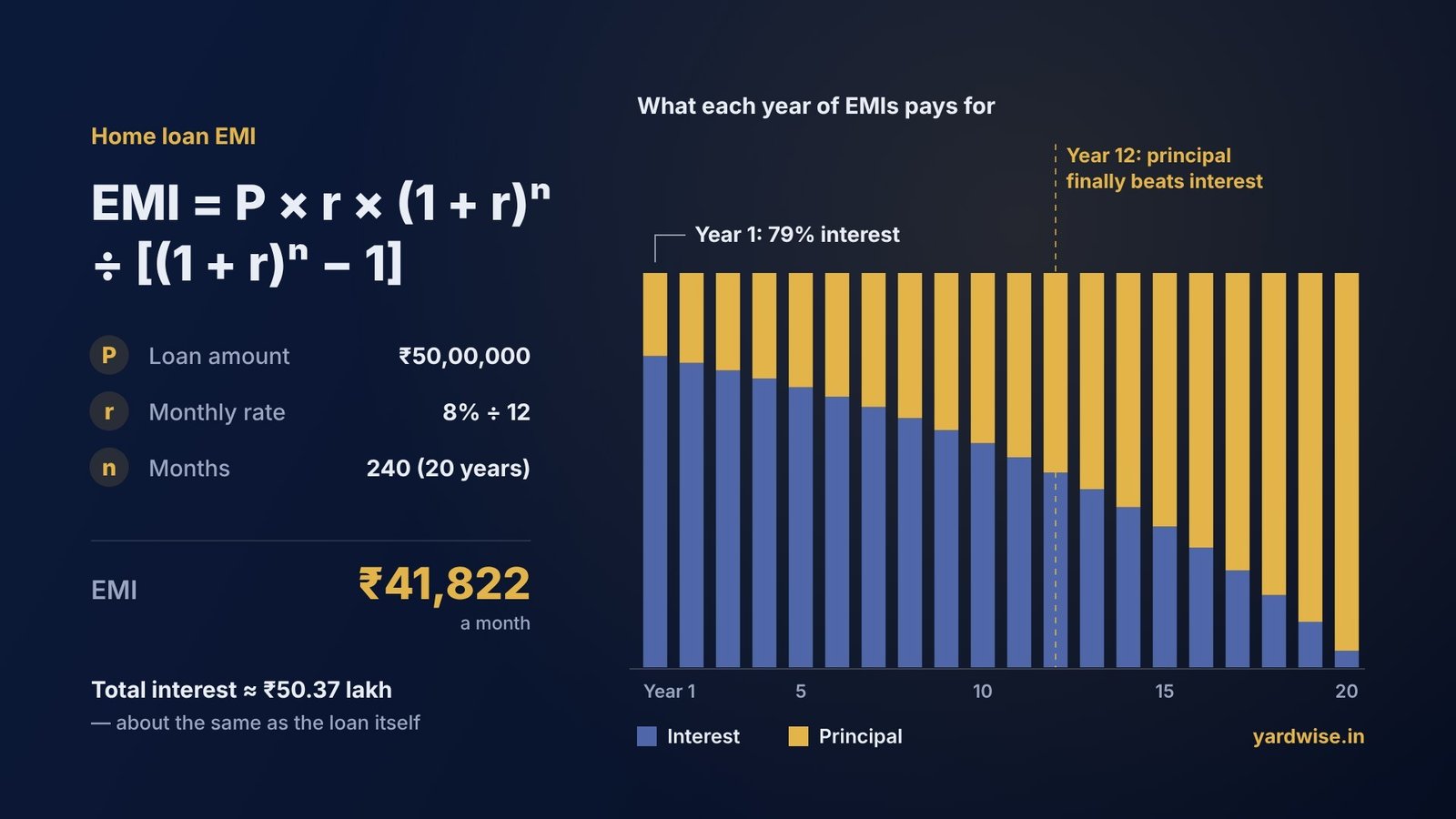
EMI = P × r × (1 + r)^n ÷ [(1 + r)^n − 1]
- P is the loan amount
- r is the monthly interest rate: the yearly rate ÷ 12 ÷ 100
- n is the number of monthly instalments: years × 12
Worked example: ₹50 lakh for 20 years at 8%
- P = ₹50,00,000
- r = 8 ÷ 12 ÷ 100 = 0.006667
- n = 20 × 12 = 240
- EMI = ₹41,822 a month
- Total paid over 20 years: about ₹1 crore
- Total interest: about ₹50.4 lakh
The interest you pay over the full term is roughly equal to the loan itself.
Why your early EMIs are mostly interest
Each month, interest is charged on the amount you still owe. At the start that amount is at its highest, so most of your EMI goes to interest.
- Month 1: ₹33,333 goes to interest and only ₹8,489 to principal
- Year 1: you pay about ₹3.96 lakh in interest and ₹1.06 lakh in principal
- After 5 years: you have paid about ₹25.1 lakh in EMIs but still owe about ₹43.8 lakh
- Year 12: the principal part of your EMI finally becomes larger than the interest part
This is why extra payments made early in the loan save the most money.
How the rate and tenure change the total cost
For the same ₹50 lakh over 20 years:
- At 7.5%: EMI ₹40,280, total interest about ₹46.7 lakh
- At 8%: EMI ₹41,822, total interest about ₹50.4 lakh
- At 8.5%: EMI ₹43,391, total interest about ₹54.1 lakh
- At 9%: EMI ₹44,986, total interest about ₹58 lakh
A difference of just 0.5% in the rate changes the total interest by roughly ₹4 lakh, so it pays to compare lenders.
Now the same loan at 8% over different tenures:
- 15 years: EMI ₹47,783, total interest about ₹36 lakh
- 20 years: EMI ₹41,822, total interest about ₹50.4 lakh
- 25 years: EMI ₹38,591, total interest about ₹65.8 lakh
- 30 years: EMI ₹36,688, total interest about ₹82.1 lakh
Stretching from 20 to 30 years lowers the EMI by about ₹5,100 a month but adds about ₹31.7 lakh in interest. Choose the shortest tenure whose EMI you can pay comfortably.
Floating rates: why your EMI or tenure can change
Most home loans in India have a floating rate. For bank loans it is usually linked to an external benchmark, such as the RBI repo rate, plus a margin set by the lender. When the benchmark moves, your rate is reset on the dates given in your loan agreement.
When rates rise, many lenders keep the EMI the same and extend the tenure instead. Check your loan statement once a year to see how many EMIs are left, and ask your lender to raise the EMI if the tenure has grown too long.
Prepayment: the biggest saving you control
Under RBI rules, banks and finance companies cannot charge a prepayment or foreclosure penalty on floating-rate loans taken by individuals for non-business purposes, which covers most home loans. Fixed-rate loans may still carry a charge, so check your sanction letter.
Here is what prepayment does to our ₹50 lakh example:
- ₹1 lakh extra at the end of every year, same EMI: the loan closes in about 14 years instead of 20, and you save around ₹17 lakh in interest.
- One-time ₹5 lakh after 3 years, same EMI (shorter tenure): the loan closes in about 16 years and 8 months, saving around ₹12 lakh.
- One-time ₹5 lakh after 3 years, lower EMI (same tenure): the EMI falls to about ₹37,331, but you save only around ₹4.2 lakh.
When you prepay, ask your lender to cut the tenure rather than the EMI if your monthly budget allows. In this example it saves almost three times as much interest.
Practical tips before you sign
- Keep all your EMIs together within about 40% of your take-home pay, so the loan stays comfortable even if expenses rise.
- Check your credit score before you apply; a stronger score usually gets a better rate.
- Compare the full cost: the interest rate, the processing fee and any other charges, not just the headline rate.
- Read the sanction letter for the benchmark, the margin and how often the rate resets.
- Keep an emergency fund of at least six months of EMIs before you start prepaying.
- Prepay early in the loan, when each rupee saves the most interest.
Rates and lending rules change, so confirm the details with your lender before you decide. This article is general information, not financial advice.
Ready to see your own numbers? Use the Yardwise EMI Calculator, or contact us about homes that fit your budget.